Start here
Coxswain is the umbrella for the agent platform. It is not itself an agent:
this repository holds the docs you're reading, manifest.toml (the file that
pins every other component to the same version, in lockstep), the one-line
installer, and the release notes. The components it pins do the work: a
cartridges repo, a graphs repo, the cox CLI, and an optional crew add-on.
Coxswain is beta. See What beta means below before you rely on it for anything you can't afford to redo by hand.
The loop
Every change a crew makes goes through the same loop. See it as a diagram.
Work arrives as intake: a ticket, a bug report, a request from a human. The coxswain dispatches it, but only within the in-flight bound — a cap on how many runs are active at once, so the crew doesn't take on more than it can review. Once dispatched, a run plans the work, builds it, and is reviewed twice over: once against the team's charter (the style and correctness rules a reviewer holds work to) and once by an adversary looking for what the charter reviewer missed. The two reviews are arbitrated into a single verdict, the result is validated against the checks the project actually runs, and the change lands on a branch. From there it becomes a pull request, and a human — or CI, or both — decides whether it merges on green.
No step in that loop writes to the system of record except the one that owns it. See conventions: single writer for why.
What you'll see
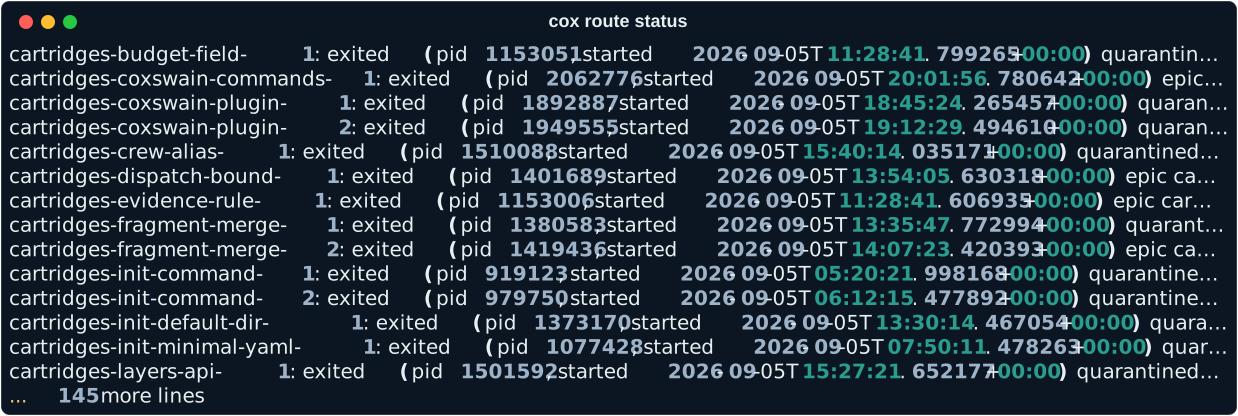
cox route status shows which provider and model tier a run will use before it starts.
Vocabulary
- crew — the agents that do the rowing: they plan, build, review, and validate. The coxswain steers; the crew rows.
- seat — one role in the crew, filled by one agent doing one job on one run: builder, charter reviewer, adversary, arbiter, validator.
- coxswain — the component that dispatches work to the crew and enforces the in-flight bound. It never does the crew's work itself.
- cartridge — a packaged bundle of context for a team or a repo: its
conventions, its charter, its thresholds. Pinned in
manifest.tomllike everything else. - fragment — one piece of context text — a convention, a charter, a style note — that gets assembled into a seat's prompt for a run.
- graph — the ordered set of nodes a run executes: plan, build, review, arbitrate, validate, and so on. Defined once, reused by every run.
- phase — an ordered stage inside an epic. Tickets within a phase aren't necessarily ordered against each other; phases are.
- task — one unit of work: one ticket, one pull request. If a task needs three PRs, it was really three tasks.
- run — one execution of a graph against one task, from intake to landing on a branch.
- docket — the queue of tasks waiting to be dispatched, respecting the in-flight bound.
- ledger — the record of what a run did: the evidence, the verdicts, the patch. What a human reads to decide whether to trust the result.
What beta means
Versions may change between releases — a flag, a file layout, a component's
shape can move without a deprecation cycle. What doesn't move is the pin:
every component in a given Coxswain release is tagged with that release's
version, so manifest.toml always tells you exactly what you have, even
while beta is still settling.